It is a fair question, and a healthy one to ask: does skincare actually do anything for the skin changes people notice during a GLP-1 journey, or is "GLP-1 skincare" just clever marketing? The honest answer has two parts. Skincare cannot change your weight or replace lost facial volume, and any product that promises to do so is overselling. But for the appearance-level changes many people notice, things like texture, hydration, fine lines, and the look of firmness, there is real evidence that a consistent routine with well-studied ingredients can help. This is an honest look at what the evidence supports, what it does not, and how to tell the difference between proof and hype.
Why the skepticism is reasonable
Skincare is an industry full of big promises, and the "GLP-1 skincare" label has been added to plenty of products that are really just ordinary moisturizers with new packaging. So skepticism is warranted. The useful thing is to separate two questions: do the ingredients have evidence behind them, and is there evidence specific to skin during a GLP-1 journey? Both matter, and they have different answers.
What the general evidence supports
Several skincare ingredients have decades of dermatology research behind them for supporting the appearance of skin quality. These are not GLP-1-specific, but they are well established:
- Retinoids for the appearance of smoother texture and fewer visible fine lines.
- Peptides for the look of firmness.
- Hyaluronic acid for a more hydrated, plumper-looking surface.
- Vitamin C and antioxidants for a brighter, more even-looking complexion.
- Daily SPF for supporting skin quality over time, which is one of the most consistently evidenced steps in all of skincare.
In other words, the core toolkit of a good routine is not hype. Our skin-quality glossary explains what each of these terms means.
What is specific to GLP-1 skin
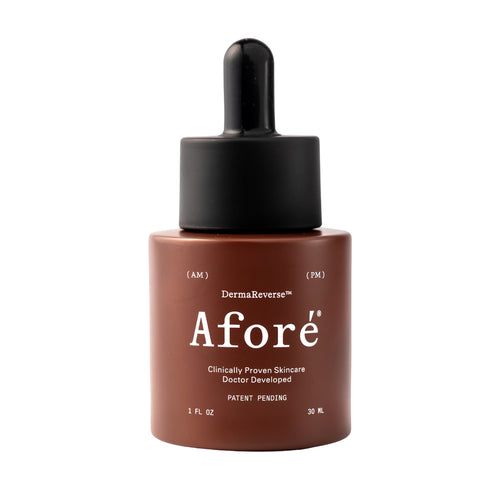
Here is the more important distinction. Most products marketed for GLP-1 users are simply general skincare with a new label. What separates evidence-backed from marketing is whether a product has been studied in this specific population. That is uncommon, and it is the gap DermaReverse was built to address.
DermaReverse was evaluated in a blinded, placebo-controlled, split-face clinical study of women using GLP-1 or SGLT-2-related therapies, published in a peer-reviewed medical journal. In it, the treated side of the face showed statistically significant visible improvement compared with placebo across the measured Global Ranking Scale domains, with improvement apparent by Day 21 and additional improvement by Day 42. No adverse events were reported. Individual results may vary, and the findings reflect the studied group rather than a guarantee for everyone. For the full details of what was measured and when, see our clinical study page.
What skincare cannot do
Being honest about the limits is part of answering the question fairly. Topical skincare cannot:
- Replace lost facial volume
- Change bone structure
- Substitute for medical care
- Do what in-office procedures such as injectables, energy-based devices, or surgery are designed to do
- Guarantee a specific visible outcome
If your main concern is volume or deeper laxity, that sits outside what a topical can address, and a qualified provider is the right resource. Our guide on skincare versus in-office treatments covers where each fits.
How to tell evidence-based from marketing
You do not need to take anyone's word for it. A few signals help you judge a skincare claim for yourself:
- Look for published, peer-reviewed studies, not vague phrases like "clinically tested" with no reference. A real study can be read and checked.
- Watch the language. Evidence-based skincare talks about supporting the appearance of skin quality, not curing, reversing, or treating a medical condition.
- Be wary of guarantees. Honest skincare says individual results may vary, because they do.
- Recognize the ingredients. Well-studied actives like retinoids, peptides, hyaluronic acid, and vitamin C are a better sign than a proprietary "miracle" with no track record.
The bottom line
Skincare will not do everything, and it is right to be skeptical of anything that claims it will. But for the appearance-level changes many people notice during a GLP-1 journey, the evidence supports that a consistent routine with well-studied ingredients can genuinely help. And for this specific population, there is now peer-reviewed clinical data rather than marketing alone. That combination, honest expectations plus real evidence, is the standard worth holding any product to.
Where DermaReverse fits
DermaReverse is Aforé's cosmetic topical serum, designed to support the appearance of firmness, hydration, texture, radiance, and overall skin quality during a GLP-1 journey. It was studied specifically in GLP-1-treated patients in the peer-reviewed, blinded, placebo-controlled study described above, used twice daily and followed by SPF 30 or higher during the day. It is a cosmetic skincare product, not a drug or medical treatment, and it is not a replacement for lost facial volume, in-office treatments, or medical care. Individual results may vary.
Explore DermaReverse · Read the clinical study
Frequently asked questions
Does skincare actually work for GLP-1 skin?
Skincare cannot change your weight or replace lost facial volume, but for appearance-level changes such as texture, hydration, fine lines, and the look of firmness, the evidence supports that a consistent routine with well-studied ingredients can help. Results vary from person to person.
Is "GLP-1 skincare" just marketing?
Often the label is added to ordinary products. What separates evidence-backed skincare from marketing is whether the product has been studied in this specific population and whether its claims are supported by published research rather than vague wording.
What skincare ingredients have evidence behind them?
Retinoids, peptides, hyaluronic acid, vitamin C and antioxidants, and daily SPF all have well-established research supporting the appearance of skin quality. These are not GLP-1-specific, but they are the evidence-based core of a good routine.
What can't skincare do for GLP-1 skin?
Topical skincare cannot replace lost facial volume, change bone structure, substitute for medical care, or do what in-office procedures are designed to do. Concerns involving volume or deeper laxity are best assessed by a qualified provider.
How can I tell if a skincare claim is evidence-based?
Look for published, peer-reviewed studies rather than vague "clinically tested" phrasing, watch for appearance-based language instead of disease claims, be wary of guaranteed results, and favor recognizable, well-studied ingredients.
References
- Semersky A, Pryor S, Barwood-Parent C, Lee M, Copeland K, Few J. A Single-Center, Blinded, Placebo-Controlled Study Evaluating Cosmetic Efficacy and Safety of a Novel Topical GLPSGLT in Glucagon-Like Peptide-1 Analog-Treated Patients. Aesthetic Surgery Journal Open Forum. 2025;7:ojaf030. doi:10.1093/asjof/ojaf030
- Zasada M, Budzisz E. Retinoids: active molecules influencing skin structure formation in cosmetic and dermatological treatments. Advances in Dermatology and Allergology. 2019;36(4):392–397. doi:10.5114/ada.2019.87443
- VanBuren CA, Everts HB. Vitamin A in Skin and Hair: An Update. Nutrients. 2022;14(14):2952. doi:10.3390/nu14142952
Disclaimer: Aforé and DermaReverse are independent and are not affiliated with, endorsed by, sponsored by, or approved by the makers of any GLP-1 medication. Ozempic® and Wegovy® are registered trademarks of Novo Nordisk A/S, and Zepbound® and Mounjaro® are registered trademarks of Eli Lilly and Company. Aforé claims no ownership of these marks and no affiliation with their owners; they are used here only to identify the medications discussed. All other trademarks are the property of their respective owners. This article discusses cosmetic, appearance-level skin quality, and nothing on this page implies that any medication causes a disease or medical condition. Aforé content is for general educational purposes only, is not medical advice, and is not a substitute for consultation with a qualified healthcare provider. Aforé products are cosmetic topical skincare products and are not intended to diagnose, treat, cure, or prevent any disease or medical condition, and are not a replacement for in-office treatment, medical care, or provider guidance. Individual results may vary.