If you've started reading about skincare during a GLP-1 journey, you've probably run into words like firmness, elasticity, hydration, texture, and radiance, often without a clear explanation of what they actually mean. This is a plain-English glossary of the skin-quality terms you'll see most, including what each one means, why you might notice a change during a period of body transformation, and what can support its appearance. It's educational, non-alarmist, and meant to help you name what you're seeing.
A quick note before the definitions: noticing changes in how your skin looks is common during body transformation, it varies a lot from person to person, and it isn't something to feel anxious about. The goal here is clarity, not concern.
What is "skin quality"?
Skin quality is a broad, umbrella term for how your skin looks and feels overall: the combined impression of firmness, elasticity, hydration, texture, smoothness, radiance, tone, pores, and fine lines. When people say their skin "looks different," they're usually describing a shift in one or more of these. The rest of this glossary breaks the umbrella into its parts.
Most of these are areas a consistent topical routine can help support. A few, like lost facial volume, sit outside what skincare can do, which we cover at the end.
Firmness
Firmness is how supported, tight, and structured the skin appears. When skin looks less firm, it can appear softer, looser, or less defined (for example, a softer-looking jawline).
Why you might notice it: the look of firmness may be influenced by many factors, including age, skin history, hydration, and the pace of body change. What supports its appearance: peptides, retinoids, daily sun protection, and steady hydration can support the look of firmer skin.
Elasticity
Elasticity is the skin's visible bounce, stretch, and resilience. When elasticity looks reduced, skin may appear less springy, less bouncy, looser, or more crepey.
Why you might notice it: visible elasticity naturally shifts with age and can look different during body transformation. What supports its appearance: hydration, antioxidants, retinoids, and consistent sun protection support the appearance of more resilient-looking skin.
Hydration
Hydration is how moisturized, supple, comfortable, and plump the skin looks and feels. Dehydrated-looking skin can appear dull, tight, rough, or less plump. (Hydration refers to water content, slightly different from "moisture," which people often use for oils and barrier support; a good routine addresses both.)
Why you might notice it: appetite and thirst can change during a GLP-1 journey, so many people simply drink less. What supports its appearance: hyaluronic acid, a good non-comedogenic moisturizer, and deliberate water intake support a more hydrated, plumper-looking surface.
Texture and surface roughness
Texture is the visible smoothness or unevenness of the skin's surface; "surface roughness" is a more clinical way to describe uneven texture. Texture concerns can show up as roughness, crepiness, unevenness, or a change in how makeup sits.
What supports its appearance: retinoids and gentle, consistent care support the appearance of smoother, more refined texture. Avoid over-exfoliating, which can leave skin looking and feeling worse.
Radiance
Radiance is how fresh, healthy-looking, and light-reflective the skin appears. Reduced radiance can look like dullness, flatness, or a tired-looking complexion.
What supports its appearance: hydration, vitamin C and antioxidants, and gentle exfoliation support a brighter, more luminous-looking complexion.
Tone and pigmentation
Tone is how even or balanced the skin's color appears. Visible unevenness can show up as dark spots, discoloration, dullness, or blotchiness, and it can be influenced by many factors, sun exposure chief among them.
What supports its appearance: daily broad-spectrum SPF 30 or higher, vitamin C, and consistent care support a more even-looking tone over time.
Pores
Pores are the skin's normal openings, which can look more noticeable when texture, hydration, smoothness, or firmness shift or when light reflects differently off the skin. Pores can't be "erased," but their appearance can look more refined.
What supports its appearance: hydration, retinoids, and smooth, well-supported skin can make pores appear less noticeable.
Fine lines and wrinkles
Fine lines and wrinkles are visible lines in the skin. Static wrinkles are visible even when the face is relaxed; dynamic wrinkles appear or deepen with expressions. Lines can look more noticeable when skin appears drier, less firm, or less plump.
What supports its appearance: retinoids, hydration, peptides, and daily sun protection support the appearance of smoother skin with fewer visible fine lines.
Skin sagging
Skin sagging generally refers to looser-looking skin or reduced visible definition, often noticed around the lower face, jawline, or neck. It's a description of how skin looks, not a judgment. Because "sagging" can involve skin quality, volume, or laxity, it deserves its own explanation. See our supportive guide to skin sagging during a GLP-1 journey.
The one distinction worth knowing: skin quality vs. volume vs. laxity
Most of the terms above fall under skin quality. This is how skin looks and feels overall, which is where a topical routine is most relevant. Two related ideas sit outside it:
- Volume is fullness beneath the skin. Topical skincare cannot replace lost facial volume. That's a conversation for a qualified aesthetic provider.
- Laxity is looseness or reduced support in the skin or tissue. Mild laxity can overlap with skin quality; deeper laxity is best evaluated by a provider.
Knowing which of the three you're noticing is the key to knowing what will actually help.
Where DermaReverse fits
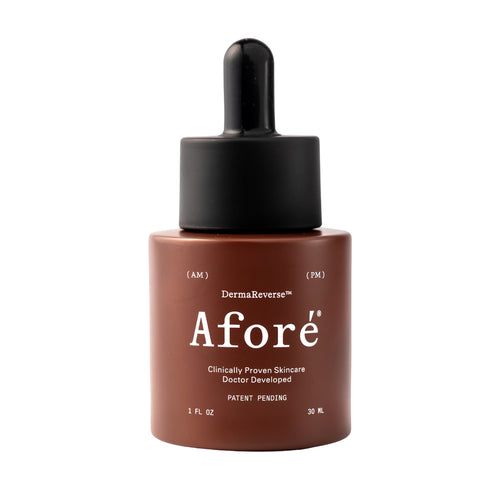
DermaReverse is Aforé's cosmetic topical serum, designed to support the appearance of firmness, hydration, texture, radiance, and overall skin quality during a GLP-1 journey. It was studied in a blinded, placebo-controlled, split-face clinical study of women using GLP-1 or SGLT-2–related therapies, published in a peer-reviewed medical journal, in which the treated side showed statistically significant visible improvement compared with placebo across the measured Global Ranking Scale domains, with improvement apparent by Day 21 and additional improvement by Day 42. No adverse events were reported. Individual results may vary. It supports the look of skin quality, it is not a replacement for lost facial volume, in-office treatments, or medical care.
Explore DermaReverse · See the 13 skin-quality domains in the clinical study
Frequently asked questions
What is skin quality?
Skin quality is a broad term for how skin looks and feels overall. It includes firmness, elasticity, hydration, texture, smoothness, radiance, tone, pores, fine lines, and the overall appearance of resilience.
What's the difference between firmness and elasticity?
Firmness is how supported and structured the skin appears, while elasticity is its visible bounce, stretch, and resilience. Skin can look less firm, less elastic, or both.
What does hydration mean in skincare?
Hydration refers to how moisturized, supple, comfortable, and plump the skin looks and feels. Dehydrated-looking skin may appear dull, tight, rough, or less plump. It relates to water content, which is slightly different from "moisture," a term often used for oils and barrier support.
What's the difference between skin quality and volume?
Skin quality is how skin looks and feels overall and is where topical skincare is most relevant. Volume is fullness beneath the skin, which topical skincare cannot replace — volume-related concerns are best assessed by a qualified provider.
What ingredients support visible skin quality?
Commonly used ingredients include hyaluronic acid for hydration, peptides for the look of firmness, retinoids for texture and fine lines, and vitamin C and antioxidants for a brighter, more even-looking complexion. Daily sun protection supports skin quality across the board.
References
- Semersky A, Pryor S, Barwood-Parent C, Lee M, Copeland K, Few J. A Single-Center, Blinded, Placebo-Controlled Study Evaluating Cosmetic Efficacy and Safety of a Novel Topical GLPSGLT in Glucagon-Like Peptide-1 Analog-Treated Patients. Aesthetic Surgery Journal Open Forum. 2025;7:ojaf030. doi:10.1093/asjof/ojaf030
- VanBuren CA, Everts HB. Vitamin A in Skin and Hair: An Update. Nutrients. 2022;14(14):2952. doi:10.3390/nu14142952
Disclaimer: Aforé and DermaReverse are independent and are not affiliated with, endorsed by, sponsored by, or approved by the makers of any GLP-1 medication. Ozempic® and Wegovy® are registered trademarks of Novo Nordisk A/S, and Zepbound® and Mounjaro® are registered trademarks of Eli Lilly and Company. Aforé claims no ownership of these marks and no affiliation with their owners; they are used here only to identify the medications discussed. All other trademarks are the property of their respective owners. This article discusses cosmetic, appearance-level changes in skin quality; nothing on this page implies that any medication causes a disease or medical condition. Aforé content is for general educational purposes only, is not medical advice, and is not a substitute for consultation with a qualified healthcare provider. Aforé products are cosmetic topical skincare products and are not intended to diagnose, treat, cure, or prevent any disease or medical condition, and are not a replacement for in-office treatment, medical care, or provider guidance. Individual results may vary.