The face gets most of the attention during a GLP-1 journey, but the neck, jawline, and décolletage often change in how they look too. These areas have thinner skin, fewer oil glands, and years of sun exposure, and they are frequently the most under-cared-for parts of a routine. The good news is that they respond to the same supportive habits as your face. In most cases you can simply extend your routine down. This is a practical guide to supporting the appearance of your neck, jawline, and décolletage, and knowing when a concern is better assessed by a professional.
As always, this is about how skin looks and feels, not a medical concern, and experiences vary from person to person. Noticing changes in these areas is common and nothing to feel self-conscious about.
Why the neck, jawline, and décolletage can change
A few things make these areas prone to visible change, and they are influences rather than a single cause. The skin here is thinner and more delicate than on the face. It has fewer oil glands, so it can look and feel drier. And the neck and chest catch a lot of sun over the years while often being left out of daily sunscreen. Add any period of body transformation, and these are simply areas where people commonly notice the look of firmness, texture, or definition shifting.
What people tend to notice
- Neck: looser-looking skin, less definition, more visible horizontal lines, or a crepey-looking texture.
- Jawline: a softer, less defined-looking contour.
- Décolletage: crepey-looking texture, fine vertical lines, and uneven-looking tone from past sun exposure.
Some of this overlaps with what people describe as skin sagging. Our supportive guide to skin sagging is a good companion if that is what you are noticing.
How to support these areas
The simplest and most effective step is to stop treating skincare as a face-only routine:
- Extend your routine down. Apply your serum and moisturizer to the neck, jawline, chin, under-chin area, and décolletage, not just the face. Avoid the delicate area directly around the eyes.
- Do not skip SPF here. Daily broad-spectrum SPF 30 or higher on the neck and chest is one of the most valuable habits for these areas, precisely because they are so often forgotten.
- Be gentle. The skin here is thinner, so avoid over-exfoliating or scrubbing, which can leave it looking and feeling worse.
- Hydrate and be consistent. These areas benefit from the same hydration and consistency that support the face. Our GLP-1 skincare routine guide covers the fundamentals.
- Mind everyday habits. Long hours looking down at a phone and dry indoor air can both affect how neck skin looks and feels over time.
Realistic expectations
It helps to be honest about what skincare can and cannot do here. A consistent routine can support the appearance of hydration, texture, smoothness, and the look of firmness on the neck, jawline, and décolletage. It cannot replace lost volume or address deeper laxity, and pronounced neck laxity in particular is something a qualified provider is best positioned to assess. If you are weighing skincare against a procedure, our guide on topical skincare versus in-office treatments can help you think it through.
When to see a provider
Consider a qualified dermatologist or aesthetic provider if you notice significant looseness or banding in the neck, more pronounced laxity, deeper folds, or changes in facial and neck balance, or if you are simply unsure what you are seeing. A provider can examine these areas and explain the options specific to you. This article does not recommend or rank any procedure.
Where DermaReverse fits
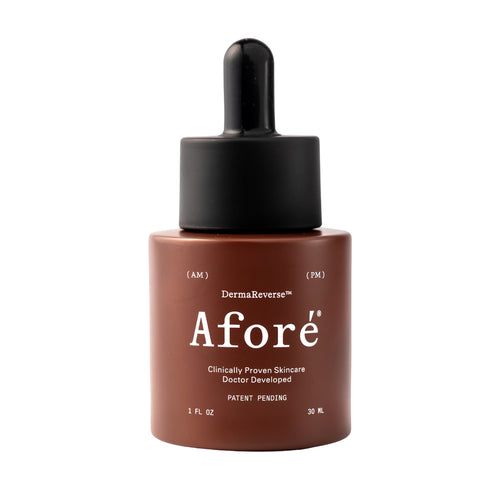
DermaReverse is Aforé's cosmetic topical serum, and it is designed to be used beyond the face. It can be applied to the face, neck, jawline, chin, under-chin area, and décolletage, avoiding the delicate area directly around the eyes. It is used twice daily and followed by SPF 30 or higher during the day, and it supports the appearance of firmness, hydration, texture, radiance, and overall skin quality. In a blinded, placebo-controlled, split-face clinical study of women using GLP-1 or SGLT-2-related therapies, published in a peer-reviewed medical journal, the treated side showed statistically significant visible improvement compared with placebo across the measured Global Ranking Scale domains, with improvement apparent by Day 21 and additional improvement by Day 42. No adverse events were reported. Individual results may vary. It is not a replacement for lost facial volume, in-office treatments, or medical care.
Explore DermaReverse · Read the clinical study
Frequently asked questions
Can I use my face skincare on my neck and chest?
In most cases, yes. Many people simply extend their routine to the neck, jawline, chin, under-chin area, and décolletage, avoiding the delicate area right around the eyes. DermaReverse is designed to be used on these areas as well as the face.
Why does neck and chest skin change during a GLP-1 journey?
The skin here is thinner, has fewer oil glands, and gets a lot of sun exposure over the years, so it is prone to visible change. Body transformation and many other factors can play a role too, and experiences vary from person to person.
How do I care for my décolletage?
Extend your serum and moisturizer down to the chest, wear daily SPF 30 or higher, and be gentle rather than over-exfoliating. Consistency matters, since this area is often overlooked.
Can skincare fix neck sagging?
Topical skincare can support the appearance of firmness, texture, and hydration on the neck. It cannot replace lost volume or address deeper laxity, and more pronounced neck laxity is best assessed by a qualified provider.
Do I really need sunscreen on my neck and chest?
Yes. The neck and chest are among the most sun-exposed and most frequently forgotten areas, so daily broad-spectrum SPF 30 or higher is one of the most valuable habits for supporting how they look over time.
References
- Semersky A, Pryor S, Barwood-Parent C, Lee M, Copeland K, Few J. A Single-Center, Blinded, Placebo-Controlled Study Evaluating Cosmetic Efficacy and Safety of a Novel Topical GLPSGLT in Glucagon-Like Peptide-1 Analog-Treated Patients. Aesthetic Surgery Journal Open Forum. 2025;7:ojaf030. doi:10.1093/asjof/ojaf030
Disclaimer: Aforé and DermaReverse are independent and are not affiliated with, endorsed by, sponsored by, or approved by the makers of any GLP-1 medication. Ozempic® and Wegovy® are registered trademarks of Novo Nordisk A/S, and Zepbound® and Mounjaro® are registered trademarks of Eli Lilly and Company. Aforé claims no ownership of these marks and no affiliation with their owners; they are used here only to identify the medications discussed. All other trademarks are the property of their respective owners. This article discusses cosmetic, appearance-level skin quality, and nothing on this page implies that any medication causes a disease or medical condition. Aforé content is for general educational purposes only, is not medical advice, and is not a substitute for consultation with a qualified healthcare provider. Aforé products are cosmetic topical skincare products and are not intended to diagnose, treat, cure, or prevent any disease or medical condition, and are not a replacement for in-office treatment, medical care, or provider guidance. Individual results may vary.