Wine & Skin · The questions worth asking · No. 1
Nine women, one dinner table, one shared complaint: everything says “clinically proven,” so it has stopped meaning anything. Here is how to read it.
The short answer
No rule fixes what “clinically proven” has to mean, so it covers everything from a lab dish to a published human trial. Four questions tell you which one you are looking at.
It can mean any of these
Same words on the box. Very different amounts of proof behind them, from least to most.
-
1
One ingredient was studied
By someone else, possibly years ago, at a dose and in a base the product may not match.
-
2
Cells in a dish
Useful for scientists. Says nothing about a face.
-
3
An animal study
Often where ingredients begin. Not where a product should end.
-
4
People said it felt better
A perception survey. “92% agreed skin felt softer.” No one checked.
-
5
Photos, no comparison
Real people, real product, but nothing to compare against except last month.
-
6
The finished formula, on people, against a placebo, published
Blinded, controlled, and reviewed by scientists who do not work for the brand.
Four questions sort them
1
Who was tested?
People or cells? How many? What ages and skin tones? Seven people and seventy people can both be real studies and mean different things.
Red flag: no sample size anywhere.
2
What exactly was tested?
The product in the bottle, or one ingredient at a different strength in a different base? Concentration and formula change everything.
Red flag: “clinically proven ingredients.”
3
Compared to what?
Nothing, a baseline photo, a placebo, or the other side of the same face. Same person, same sun, same diet is the strongest control a topical can get.
Red flag: before-and-afters with no dates.
4
Where can I read it?
A published paper shows who ran it, who paid, what went wrong, and what the authors admit they do not know.
Red flag: a “study” you cannot find.
We graded our own study by the same four
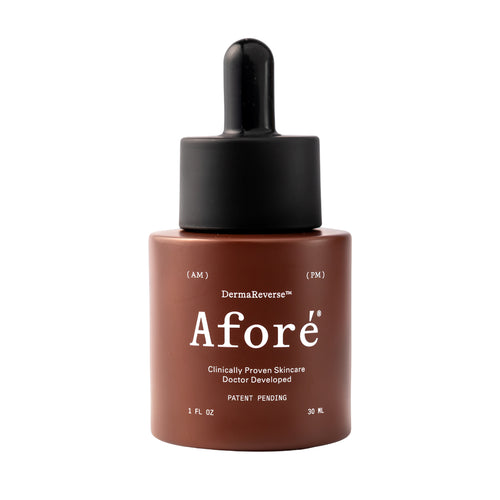
DermaReverse has one published study. Here is how it answers each question, including the parts that are not flattering.
| Question | Our study | Honest note |
|---|---|---|
| Who was tested? | 7 adult women, median age 55, at one clinic. Three Fitzpatrick skin-type categories. | Small. One center. Not every skin type. The authors call it a pilot. |
| What exactly? | The finished DermaReverse formula, twice daily for six weeks, with a cleanser, moisturizer and SPF 30. | The companion products were the same on both sides of the face, so the serum is the only difference. |
| Compared to what? | A placebo on the other side of the same face. Participants, evaluators and the investigator were blinded. A plastic surgeon who did not know which side was which reviewed standardized photos. | The treated side scored better than placebo on all 13 measures, visible by day 21, more by day 42. No adverse events were reported. The authors note that scores for facial volume may reflect subjective judgment; a serum does not replace lost volume. |
| Where can I read it? | Aesthetic Surgery Journal Open Forum, 2025, open access. The paper states the authors received no financial support for the research. | I am the first author and Dr. Julius Few is the senior author. We are the company. Read it and decide for yourself. |
Our grade
Strong design, small sample. Enough to say the serum did better than placebo in this group over six weeks. Not enough to promise anyone their result.
Three red flags on any label
Keep this
Before you trust the label
- Who was tested?
- What exactly?
- Compared to what?
- Where can I read it?
Next in Wine & Skin: How to tell a real before-and-after from a flattering one.
Sources
- Semersky A, Pryor S, Barwood-Parent C, Lee M, Copeland K, Few J. A Single-Center, Blinded, Placebo-Controlled Study Evaluating Cosmetic Efficacy and Safety of a Novel Topical GLPSGLT in Glucagon-Like Peptide-1 Analog-Treated Patients. Aesthetic Surgery Journal Open Forum. 2025;7:ojaf030. doi:10.1093/asjof/ojaf030
- Aforé, The DermaReverse clinical study, explained simply.
Aforé content is educational and is not medical advice. DermaReverse is a cosmetic topical skincare product and is not intended to diagnose, treat, cure, or prevent any disease. Individual results may vary.