"Ozempic face", the visible facial changes some people notice during a GLP-1 journey, sometimes also called "GLP face", isn't necessarily permanent, but it also doesn't follow one fixed path. Whether the look eases over time varies a lot from person to person and may be influenced by many factors, including age, genetics, facial structure, sun exposure, the pace of body change, and overall skin quality. The reassuring part: the appearance of skin quality can often be supported day to day, while changes tied to lost facial volume or deeper laxity are best assessed by a qualified provider. This isn't something to feel anxious about, it's something to understand.
If your skin looks or feels different during a period of meaningful body transformation, it makes sense to have questions. You can be proud of your progress and still want support for your skin. Those feelings can coexist. This guide walks through what "going away" actually depends on, without alarm and without overpromising.
First, a quick recap of what "Ozempic face" means
"Ozempic face" is an informal, non-medical nickname for a cluster of visible changes some people notice around the face during a GLP-1 journey: things like softer-looking contours, less definition along the jawline, skin that looks less firm or less hydrated, more noticeable fine lines, or a more tired-looking appearance. Some people prefer the term "GLP face." Either way, it's a description of how skin looks, not a diagnosis. Experiences vary widely, and not everyone notices the same changes. Our complete guide covers what it is, why it happens, and what the research shows.
Does Ozempic face go away on its own?
There's no single answer, because it depends on what you're actually noticing. Some people report that certain visible changes ease as their body composition stabilizes and their weight settles, particularly changes tied to hydration and overall skin comfort. Others find that some of the appearance of firmness or fullness doesn't simply return on its own. It's less a matter of "it goes away" or "it doesn't," and more that different aspects respond differently, which is why the skin-quality-versus-volume distinction below matters so much.
What's fair to say: the appearance of your skin is not fixed, it can often be supported, and you don't need to solve everything overnight.
Is Ozempic face permanent?
Not necessarily, and it's rarely helpful to think in terms of "permanent" at all. Visible skin changes can be influenced by a wide range of factors, and how the appearance evolves is individual. Rather than a yes-or-no, it's more useful to identify what you're noticing, support what can be supported, and get qualified guidance for anything that feels beyond skincare.
Why it varies so much from person to person
Two people on similar journeys can have very different experiences with how their skin looks. Visible skin quality may be influenced by:
- Age and genetics
- Facial structure and starting facial fullness
- Skin history and past sun exposure
- Hydration and daily skincare habits
- Aesthetic treatment history
- The pace and degree of body transformation
- Lifestyle factors such as sleep, stress, and overall hydration
Because so many factors are in play, no one can promise a specific outcome, and anyone who does should be treated with skepticism.
The key distinction: skin quality vs. volume vs. laxity
This is the single most useful thing to understand when you're wondering whether the look will ease. When someone says their skin is "sagging" or their face looks different, they may actually be noticing one of three different things — or a combination — and each responds differently.
Skin quality
How your skin looks and feels overall: hydration, firmness, texture, smoothness, radiance, tone, pores, fine lines, and visible resilience. This is the area where a consistent topical routine is most relevant. It can support the appearance of healthier-looking, more hydrated, firmer-looking skin.
Volume
Fullness beneath the skin. Topical skincare cannot replace lost facial volume. If the main thing you're noticing is deflation or hollowing, that's a conversation for a qualified aesthetic provider.
Laxity
Looseness or reduced support in the skin or underlying tissue. Some mild visible laxity overlaps with skin quality, while deeper laxity is best evaluated by a provider.
So "does it go away?" honestly depends on which of these you're seeing. The skin-quality piece is often the most supportable; volume and deeper laxity are where professional guidance comes in. Our guide to saggy-looking skin after weight loss goes deeper on this.
What can support the appearance of your skin as it changes
None of this changes your weight or replaces professional care; but, a steady, simple routine can support how your skin looks day to day. The fundamentals that dermatology consistently points to:
- Support hydration first, especially if skin feels drier, tighter, or less comfortable than usual.
- Use daily broad-spectrum SPF 30 or higher — one of the most consistently recommended steps for maintaining visible skin quality over time.
- Keep the routine simple enough to actually follow. Consistency tends to matter more than complexity.
- Be thoughtful with active ingredients. More strong actives at once isn't automatically better, and can leave skin reactive.
- Give it time, and track gently — similar lighting and angles every few weeks — without turning your skin into something to critique.
Supportive ingredients often used for the appearance of skin quality include peptides (for the look of firmness), hyaluronic acid (for a hydrated, plumper-looking surface), and retinoids (for the appearance of smoother texture and fewer visible fine lines). Our GLP-1 skincare routine guide lays out a simple morning and night structure.
When to consider a qualified provider
Skincare and in-office treatments serve different roles, and it's worth speaking with a qualified provider if you're noticing:
- Significant changes in facial fullness or facial balance
- More pronounced skin sagging or deeper laxity
- Neck or jawline changes, or deeper folds
- Texture concerns that feel beyond topical care
- Uncertainty about what you're actually noticing
A provider can help distinguish skin quality, volume, and laxity, and talk through what — if anything — is appropriate. There's no rush, and there's no single right answer for everyone.
Where DermaReverse fits
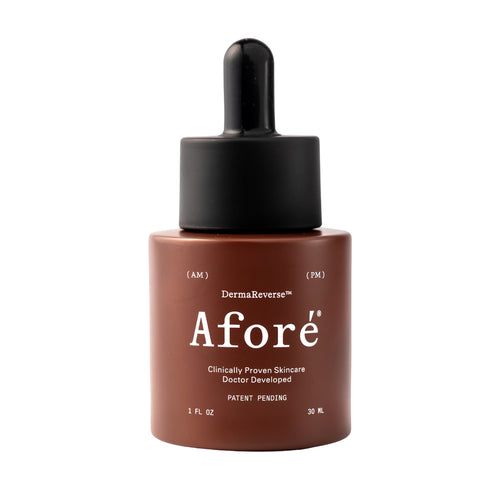
DermaReverse is Aforé's cosmetic topical serum, developed for targeted visible skin-quality support during a GLP-1 journey. It's designed to support the appearance of hydration, texture, firmness, radiance, and overall skin quality. It was clinically tested in GLP-1 treated patients in a peer-reviewed, medical-journal-published clinical study that evaluated visible skin-quality domains including hydration, texture, surface roughness, pigmentation, visible pores, static wrinkles, firmness, and radiance. It is a topical skincare product, not a drug, and not a replacement for lost facial volume, in-office treatments, or medical care.
Explore DermaReverse · Read the clinical study
Frequently asked questions
Does Ozempic face go away on its own?
It varies, and it depends on what you're noticing. Some people report that certain visible changes, especially those tied to hydration and skin comfort, ease as their body composition stabilizes, while the appearance of firmness or fullness may not simply return on its own. The appearance of skin quality can often be supported day to day.
Is Ozempic face permanent?
Not necessarily. Visible skin changes can be influenced by many factors, including age, genetics, facial structure, sun exposure, and the pace of body change, so how the appearance evolves is individual. It's more useful to identify what you're noticing and support it than to think in terms of "permanent."
Can skincare help with how my skin looks during a GLP-1 journey?
Topical skincare can support the appearance of skin quality — hydration, texture, smoothness, radiance, firmness, and elasticity. It cannot replace lost facial volume or do what certain in-office treatments are designed to do.
What's the difference between skin quality, volume, and laxity?
Skin quality is how skin looks and feels overall and is where topical skincare is most relevant. Volume is fullness beneath the skin, which topical skincare cannot replace. Laxity is looseness or reduced support; mild laxity may overlap with skin quality, while deeper laxity is best evaluated by a qualified provider.
When should I speak with a professional?
Consider a qualified provider if you notice significant changes in facial fullness, more pronounced skin sagging or deeper laxity, neck or jawline changes, texture concerns beyond topical care, or if you're simply unsure what you're seeing.
References
- Semersky A, Pryor S, Barwood-Parent C, Lee M, Copeland K, Few J. A Single-Center, Blinded, Placebo-Controlled Study Evaluating Cosmetic Efficacy and Safety of a Novel Topical GLPSGLT in Glucagon-Like Peptide-1 Analog-Treated Patients. Aesthetic Surgery Journal Open Forum. 2025;7:ojaf030. doi:10.1093/asjof/ojaf030
- Ridha Z, Fabi SG, Zubair R, Dayan SH. Decoding the Implications of Glucagon-like Peptide-1 Receptor Agonists on Accelerated Facial and Skin Aging. Aesthetic Surgery Journal. 2024;44(11):NP809–NP818. doi:10.1093/asj/sjae132
- VanBuren CA, Everts HB. Vitamin A in Skin and Hair: An Update. Nutrients. 2022;14(14):2952. doi:10.3390/nu14142952
Disclaimer: Aforé and DermaReverse are independent and are not affiliated with, endorsed by, sponsored by, or approved by the makers of any GLP-1 medication. Ozempic® and Wegovy® are registered trademarks of Novo Nordisk A/S, and Zepbound® and Mounjaro® are registered trademarks of Eli Lilly and Company. Aforé claims no ownership of these marks and no affiliation with their owners; they are used here only to identify the medications discussed. All other trademarks are the property of their respective owners. This article discusses cosmetic, appearance-level changes in skin quality; nothing on this page implies that any medication causes a disease or medical condition. Aforé content is for general educational purposes only, is not medical advice, and is not a substitute for consultation with a qualified healthcare provider. Aforé products are cosmetic topical skincare products and are not intended to diagnose, treat, cure, or prevent any disease or medical condition, and are not a replacement for in-office treatment, medical care, or provider guidance. Individual results may vary.